 Tilda
Tilda
When you’re new to quilting, the terminology can feel confusing and even intimidating. Quilt patterns, tutorials, and supply lists often assume you already understand the language of quilting — but the truth is that every quilter starts as a beginner.
Learning common quilting terms early will save you time, prevent mistakes, and help you follow instructions with confidence. This beginner-friendly glossary explains the most important quilting terms you need to know, using clear and simple language so you can enjoy the quilting process instead of feeling overwhelmed.
Whether you’re reading your first quilt pattern or shopping for supplies, this guide will help you understand exactly what each term means and how it’s used.
Quilting Basics
Quilting
Quilting is the process of sewing together three layers — the quilt top, batting, and backing — to create a finished quilt. The stitches not only hold the layers together but also add texture and design to the quilt.
Quilt
A quilt is a finished textile made of three layers stitched together. Quilts can be decorative, functional, or both, and they are often used as blankets, wall hangings, or heirloom pieces.
Quilt Top
The quilt top is the decorative upper layer of the quilt. It is usually made by piecing together smaller pieces of fabric into blocks or patterns.
Batting
Batting is the soft middle layer of the quilt that provides warmth and thickness. It sits between the quilt top and the backing.
Backing
The backing is the fabric layer on the back of the quilt. It can be a single piece of fabric or pieced together from multiple sections.
Fabric & Cutting Terms
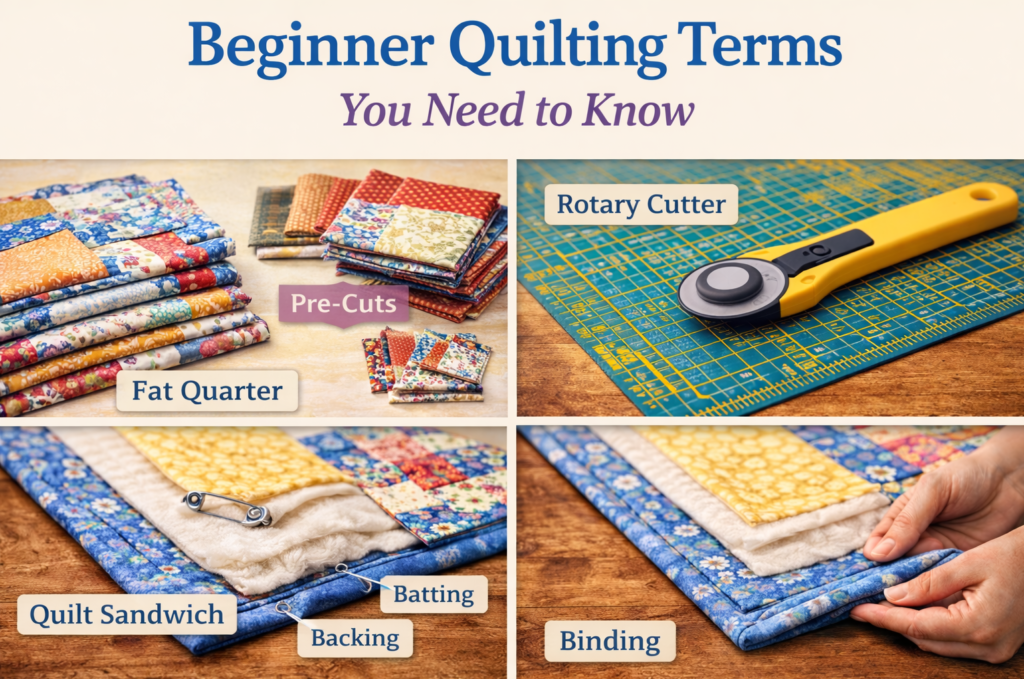
Fat Quarter
A fat quarter is a pre-cut piece of fabric measuring approximately 18 x 22 inches. It is cut wider than a standard quarter-yard, making it very versatile and popular with beginners.
Pre-Cuts
Pre-cuts are fabric bundles that come already cut into specific sizes. Common types include:
- Charm packs (5 x 5 inch squares)
- Jelly rolls (2.5-inch-wide strips)
- Layer cakes (10 x 10 inch squares)
Pre-cuts save time and reduce cutting errors, making them ideal for beginners.
Rotary Cutter
A rotary cutter is a circular cutting tool used with a quilting ruler and cutting mat. It allows for precise, straight cuts and is much faster than scissors.
Cutting Mat
A cutting mat is a self-healing surface that protects your table and keeps rotary cutter blades sharp.
Grain of Fabric
The grain refers to the direction of the threads in fabric. Cutting along the correct grain helps prevent stretching and distortion.
Sewing & Piecing Terms
Piecing
Piecing is the process of sewing individual fabric pieces together to form quilt blocks or the quilt top.
Quilt Block
A quilt block is a unit or section of a quilt top. Multiple blocks are sewn together to create the full design.
Seam Allowance
The seam allowance is the distance between the fabric edge and the stitching line. Quilting patterns typically use a ¼-inch seam allowance, which helps pieces fit together accurately.
Pressing
Pressing means using an iron to flatten seams by lifting and pressing, rather than sliding the iron back and forth. Pressing improves accuracy and keeps fabric from stretching.
Chain Piecing
Chain piecing is a technique where you sew multiple fabric pieces continuously without cutting the thread between seams. It saves time and thread.
Quilting & Assembly Terms
Quilt Sandwich
The quilt sandwich refers to the three layers stacked together: quilt top, batting, and backing. These layers are secured before quilting begins.
Basting
Basting temporarily holds the quilt layers together. Common basting methods include:
- Safety pin basting
- Spray basting
- Hand basting
Pin basting is often the easiest option for beginners.
Straight-Line Quilting
Straight-line quilting uses straight stitches across the quilt and is one of the most beginner-friendly quilting methods.
Free-Motion Quilting
Free-motion quilting allows you to move the fabric freely under the needle to create decorative designs. This technique usually comes later, after mastering basic quilting.
Finishing Terms
Binding
Binding is the fabric strip sewn around the edges of the quilt to finish it and secure all layers together.
Double-Fold Binding
Double-fold binding is made by folding fabric strips in half lengthwise, creating a durable edge that is commonly used in quilts.
Mitered Corner
A mitered corner is a diagonal fold at the quilt corners that creates a neat, professional-looking finish.
Squaring Up
Squaring up means trimming the quilt so that all edges and corners are straight and even.
Tools & Equipment Terms
Walking Foot
A walking foot is a sewing machine foot that feeds the top and bottom layers of fabric evenly. It is especially helpful when quilting through multiple layers.
Quilting Needle
A quilting needle is designed to handle multiple layers of fabric and batting without bending or breaking.
Thimble
A thimble protects your finger when hand sewing or hand quilting.
Helpful Beginner Terms
Stitch in the Ditch
Stitch in the ditch means quilting directly along seam lines so the stitches blend into the quilt design.
Selvage
The selvage is the finished edge of the fabric that prevents fraying. It usually contains printed information and is trimmed off before sewing.
Notions
Notions refer to small sewing tools and accessories such as pins, clips, needles, seam rippers, and marking tools.
UFO (Unfinished Object)
A common quilting term for a project that has been started but not finished — something every quilter eventually has.
Why Learning Quilting Terms Matters
Understanding quilting terminology helps you:
- Read and follow patterns accurately
- Shop for the correct supplies
- Avoid common beginner mistakes
- Learn new techniques faster
Once you understand the language of quilting, everything else becomes easier and more enjoyable.
Final Thoughts
Learning common quilting terms is one of the best ways to build confidence as a beginner. This glossary gives you a strong foundation so you can read patterns, follow tutorials, and explore quilting techniques without confusion.
As you continue quilting, these terms will quickly become second nature — and your skills will grow with every project.
Your quilting journey has just begun.